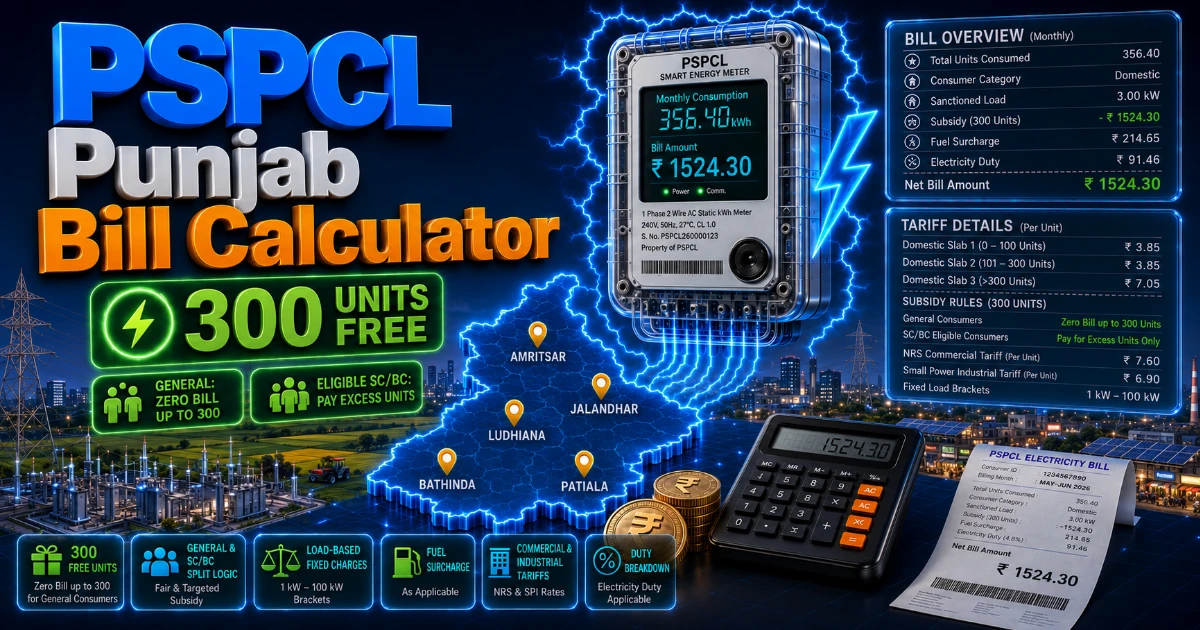
Calculating a Punjab electricity bill manually can be difficult because the payable amount depends on monthly consumption, consumer category, sanctioned load, government subsidy eligibility, fixed charges, fuel surcharge, and Electricity Duty.
- What Is the PSPCL Electricity Bill Calculator?
- PSPCL Domestic Electricity Tariff Slabs
- Punjab Government 300 Free Units Scheme
- Domestic Load-Based Fixed Charges
- Fuel Surcharge and Electricity Duty
- Supported PSPCL Connection Categories
- How to Use the PSPCL Electricity Bill Calculator
- Key Features of the PSPCL Electricity Bill Calculator
- How the Estimated PSPCL Bill Is Prepared
- Why Is Our PSPCL Electricity Bill Calculator Different From Other Tools?
- PSPCL Domestic Tariff and Subsidy Structure
- How the General Category Subsidy Is Calculated
- How the SC, BC, BPL, and Freedom Fighter Benefit Is Calculated
- Domestic Load-Based Fixed Charges
- Non-Residential Supply Commercial Tariff
- Small Power Industrial Tariff
- How the Estimated PSPCL Bill Is Calculated
- Electricity-Saving Tips for PSPCL Consumers
- Frequently Asked Questions
The PSPCL Electricity Bill Calculator is an online utility designed for consumers served by Punjab State Power Corporation Limited. It helps domestic households, commercial establishments, small industries, and other supported connection categories estimate their monthly electricity expenses before receiving the official bill.
Using the supplied Punjab State Electricity Regulatory Commission FY 2026–27 tariff information, the calculator supports domestic energy slabs, the configured Punjab Government 300 Free Units Scheme, separate General and SC/BC beneficiary rules, Non-Residential Supply Commercial tariffs, Small Power Industrial charges, load-based fixed charges, fuel surcharge, and 18% Electricity Duty.
The tool is intended for eligible PSPCL consumers across Ludhiana, Amritsar, Jalandhar, Patiala, Bathinda, and other electricity distribution areas throughout Punjab.
Electricity consumption can vary considerably between different consumers. A small household may remain within the 300-unit subsidy limit, while a larger household using air conditioners, water pumps, refrigerators, heaters, and other appliances may cross the free-unit threshold. Shops, offices, restaurants, workshops, and industrial units follow separate tariffs and load-based charges.
The calculator simplifies the complete process by displaying gross energy charges, fixed monthly charges, fuel surcharge, Electricity Duty, government subsidy adjustment, and the estimated net payable amount in an itemized report.
What Is the PSPCL Electricity Bill Calculator?
The PSPCL Electricity Bill Calculator is an online electricity bill estimation tool for consumers of Punjab State Power Corporation Limited.
It calculates an expected monthly bill using total electricity consumption, connection category, sanctioned load, and applicable domestic subsidy status.
Unlike a basic electricity calculator that multiplies all consumed units by one general rate, this tool follows the supplied domestic tariff and subsidy rules.
The calculator distinguishes between:
- Domestic General Category consumers
- Eligible Domestic SC, BC, BPL, and Freedom Fighter beneficiaries
- Non-Residential Supply Commercial consumers
- Small Power Industrial consumers
- Other categories after applicable tariffs are configured
The distinction between General and eligible special-category domestic consumers is important because the billing treatment changes when monthly consumption exceeds 300 units.
PSPCL Domestic Electricity Tariff Slabs
Under the supplied FY 2026–27 tariff information, the domestic energy rates are:
- 0–300 units: ₹3.85 per unit
- Above 300 units: ₹7.05 per unit for units falling above the 300-unit threshold under the configured slab calculation
For a domestic consumer using more than 300 units, the calculator can divide consumption across the supplied tariff slabs:
- The first 300 units are calculated at ₹3.85 per unit.
- Units exceeding 300 are calculated at ₹7.05 per unit.
- The applicable fixed monthly charge is selected according to sanctioned load.
- Fuel surcharge and Electricity Duty are calculated separately.
- The subsidy adjustment is applied according to the selected consumer category.
For example, gross energy charges for 350 units under the supplied slab structure are:
- First 300 units: 300 × ₹3.85 = ₹1,155
- Remaining 50 units: 50 × ₹7.05 = ₹352.50
- Total gross energy charge: ₹1,507.50
The final payable amount depends on whether the consumer belongs to the General Category or an eligible SC/BC-related beneficiary category.
Punjab Government 300 Free Units Scheme
The calculator supports the supplied Punjab Government 300 Free Units Scheme configuration for eligible domestic electricity consumers.
The subsidy treatment is different for General Category and eligible SC, BC, BPL, or Freedom Fighter consumers.
General Category Subsidy Rule
- Monthly consumption up to 300 units: The supplied configuration applies a 100% subsidy and an estimated net bill of ₹0.
- Monthly consumption above 300 units: The subsidy is removed, and the complete billed consumption becomes payable according to the configured domestic tariff rules.
For example, a General Category household using 280 units may receive the configured zero-bill benefit. However, if usage increases to 301 units, the normal domestic bill calculation applies without the 300-unit subsidy.
SC, BC, BPL, and Freedom Fighter Subsidy Rule
- Monthly consumption up to 300 units: The supplied configuration provides a 100% subsidy and an estimated net bill of ₹0.
- Monthly consumption above 300 units: The first 300 units remain covered, while only the excess units are treated as payable under the configured benefit.
For example, when an eligible beneficiary uses 350 units, the calculator treats the first 300 units as subsidized and calculates payable energy charges for the remaining 50 units.
The subsidy option should only be selected by consumers who are officially registered and eligible. Selecting a category in the calculator does not independently confirm government subsidy eligibility.
The itemized report can display gross energy charges, subsidy deduction, excess payable units, fixed charges, fuel surcharge, Electricity Duty, and the estimated final bill separately.
Domestic Load-Based Fixed Charges
The supplied domestic fixed monthly charge depends on sanctioned load:
- Load up to 2 kW: ₹35 per month
- Load from 2.1 to 7 kW: ₹55 per month
- Load from 7.1 to 20 kW: ₹85 per month
- Load above 20 kW: ₹105 per month
For example, a household with a sanctioned load of 2 kW receives a ₹35 fixed charge, while a connection with a 5 kW sanctioned load receives a ₹55 fixed charge.
Consumers should enter the sanctioned load printed on their latest PSPCL electricity bill or connection document. Estimating the value from installed appliances may produce an inaccurate result.
Fuel Surcharge and Electricity Duty
The supplied PSPCL calculator configuration includes:
- Fuel surcharge: ₹0.10 per billed unit
- Electricity Duty: 18% according to the taxable billing components configured in the tool
- Billing cycle: One month
For example, fuel surcharge for 280 units is:
280 × ₹0.10 = ₹28
The calculator displays Electricity Duty and fuel surcharge separately. The exact official duty base and subsidy treatment of statutory charges should be compared with the latest PSPCL bill.
Supported PSPCL Connection Categories
The calculator can support the following categories using the supplied tariff information:
- Domestic General Category
- Domestic SC/BC/BPL/Freedom Fighter Category
- Non-Residential Supply Commercial
- Small Power Industrial
- EV Charging after the applicable tariff is configured
A specific EV Charging energy rate and fixed-charge rule were not included in the supplied data. The EV option should only be activated after the applicable tariff has been configured.
How to Use the PSPCL Electricity Bill Calculator
Calculate Your PSPCL Bill in Four Steps
Step 1: Select the Consumer Category
Choose Domestic General, eligible Domestic SC/BC, Commercial NRS, Small Power Industry, or another fully configured category.
Step 2: Enter Monthly Consumption
Enter the total electricity units recorded during the monthly billing cycle.
Step 3: Enter Sanctioned Load
Enter the official connected or sanctioned load in kW to calculate the applicable fixed charge.
Step 4: Calculate the Bill
Click Calculate Bill to view energy charges, subsidy adjustment, fixed charges, fuel surcharge, Electricity Duty, and the estimated payable amount.
Key Features of the PSPCL Electricity Bill Calculator
- 300 free-unit scheme integration: Applies the configured benefit according to consumer category and monthly usage.
- General and SC/BC split logic: Handles different treatment after crossing the 300-unit threshold.
- Domestic slab calculation: Separates the first 300 units and excess consumption.
- Load-based fixed charges: Selects the correct ₹35–₹105 domestic charge.
- Commercial tariff support: Calculates NRS consumption at the supplied ₹7.00-per-unit rate.
- Industrial tariff support: Calculates Small Power Industry bills using ₹5.30 per unit and ₹115 per kW.
- Fuel surcharge calculation: Adds the configured ₹0.10 for every applicable unit.
- Detailed report: Displays gross charges, subsidy, duty, fixed charges, and estimated net bill.
How the Estimated PSPCL Bill Is Prepared
The calculator first identifies the selected consumer category, monthly electricity consumption, sanctioned load, and subsidy rule.
Domestic energy charges are calculated according to the supplied tariff slabs. The calculator then selects the applicable load-based fixed charge, adds fuel surcharge and configured Electricity Duty, and applies the relevant government subsidy adjustment.
Commercial and Small Power Industrial connections use their supplied category-specific energy and fixed demand charges.
The result remains an estimate. An official PSPCL bill may include arrears, delayed payment surcharge, meter charges, security-deposit adjustments, subsidy corrections, penalties, rounding differences, fuel-surcharge revisions, or updated regulatory components.
Why Is Our PSPCL Electricity Bill Calculator Different From Other Tools?
A Punjab electricity bill cannot always be estimated by multiplying total monthly units by a single tariff rate. Domestic billing depends on total consumption, consumer category, sanctioned load, fuel surcharge, Electricity Duty, and eligibility under the configured 300 Free Units Scheme.
The subsidy calculation is especially important because General Category and eligible SC, BC, BPL, or Freedom Fighter consumers follow different rules after monthly consumption exceeds 300 units.
The PSPCL Electricity Bill Calculator processes these components separately. It calculates gross energy charges, identifies the applicable subsidy rule, selects the sanctioned-load-based fixed charge, adds fuel surcharge, calculates the configured Electricity Duty, and displays an itemized estimated payable amount.
| Feature | PSPCL Calculator | Basic Calculator |
|---|---|---|
| 300-Unit Subsidy | Checks category and monthly usage | May deduct 300 units from every bill |
| General vs SC/BC Logic | Applies separate threshold rules | May treat all beneficiaries equally |
| Fixed Monthly Charge | Selects charge according to sanctioned load | May ignore connected load |
| Tax and Surcharge Report | Shows Electricity Duty and fuel surcharge separately | Usually displays only a rough total |
PSPCL Domestic Tariff and Subsidy Structure
| Consumption Bracket | Energy Rate | General Category | Eligible SC/BC Category |
|---|---|---|---|
| 0–300 units | ₹3.85/unit | Configured zero-bill benefit when usage stays within 300 units | First 300 units covered under the configured benefit |
| Above 300 units | ₹7.05/unit for excess-slab units | No subsidy; complete gross bill becomes payable | Only consumption exceeding 300 units is treated as payable under the supplied rule |
The calculator should first prepare the gross domestic bill. It then applies the subsidy treatment according to the selected beneficiary category.
How the General Category Subsidy Is Calculated
Under the supplied configuration, a General Category domestic consumer receives the 300-unit benefit only when total monthly consumption remains at or below 300 units.
- Up to 300 units: The configured subsidy may reduce the eligible net bill to ₹0.
- Above 300 units: The subsidy is removed and the complete calculated bill becomes payable.
The calculator should not simply subtract 300 units from a General Category bill after the threshold has been crossed.
Example: General Category Consumer Using 280 Units
Suppose a General Category household uses 280 units with a sanctioned load of 2 kW.
- Gross energy charge: 280 × ₹3.85 = ₹1,078
- Fixed monthly charge: ₹35
- Fuel surcharge: 280 × ₹0.10 = ₹28
- Configured Electricity Duty: Calculated separately
- Subsidy: Applied when the consumer satisfies the scheme conditions
- Estimated net bill: ₹0 under the supplied zero-bill configuration
The report can still show the gross bill components before applying the subsidy so the estimated benefit remains transparent.
Example: General Category Consumer Using 350 Units
Since consumption exceeds 300 units, the General Category subsidy is not available.
- First 300 units: 300 × ₹3.85 = ₹1,155
- Remaining 50 units: 50 × ₹7.05 = ₹352.50
- Total energy charge: ₹1,507.50
- Fixed charge for 2 kW: ₹35
- Fuel surcharge: 350 × ₹0.10 = ₹35
- Subtotal before duty: ₹1,577.50
- Illustrative duty on energy charge: 18% of ₹1,507.50 = ₹271.35
- Illustrative estimated total: ₹1,848.85
This illustration applies Electricity Duty to the energy charge only. The official duty base should be confirmed from the latest PSPCL bill.
How the SC, BC, BPL, and Freedom Fighter Benefit Is Calculated
Under the supplied special-category configuration, the first 300 monthly units remain covered for an eligible registered beneficiary. When consumption exceeds 300 units, only the excess units are treated as payable.
- Up to 300 units: Configured zero-net-bill benefit.
- Above 300 units: Energy charges are calculated for units exceeding 300.
- Fixed charges and statutory components: Applied according to the calculator’s configured subsidy treatment.
Example: Eligible SC/BC Consumer Using 350 Units
- Subsidized units: First 300 units
- Payable excess units: 350 − 300 = 50 units
- Excess energy charge: 50 × ₹7.05 = ₹352.50
- Fixed monthly charge for 2 kW: ₹35
- Fuel surcharge: Applied according to the configured eligible-unit basis
- Electricity Duty: Calculated on the taxable amount configured in the tool
The official scheme may specify how fixed charges, duty, fuel surcharge, arrears, and other non-energy components are treated. The calculator should display these separately instead of assuming that every component is waived.
Domestic Load-Based Fixed Charges
| Sanctioned Load | Fixed Monthly Charge |
|---|---|
| Up to 2 kW | ₹35 |
| 2.1–7 kW | ₹55 |
| 7.1–20 kW | ₹85 |
| Above 20 kW | ₹105 |
The fixed charge depends on sanctioned load rather than electricity consumption. Consumers should use the official kW value printed on their bill.
Non-Residential Supply Commercial Tariff
The NRS Commercial category may apply to eligible shops, offices, restaurants, clinics, hotels, showrooms, and other non-residential premises.
- Energy charge: ₹7.00 per unit
- Fixed demand charge: ₹105 per kW per month
- Domestic subsidy: Not applicable
Example: Commercial Consumer Using 400 Units
For a commercial connection using 400 units with a sanctioned load of 5 kW:
- Energy charge: 400 × ₹7.00 = ₹2,800
- Fixed demand charge: 5 × ₹105 = ₹525
- Fuel surcharge: 400 × ₹0.10 = ₹40
- Subtotal before duty: ₹3,365
- Illustrative duty on energy charge: 18% of ₹2,800 = ₹504
- Illustrative estimated total: ₹3,869
Small Power Industrial Tariff
- Energy charge: ₹5.30 per unit
- Fixed demand charge: ₹115 per kW per month
- Domestic subsidy: Not applicable
Example: Small Power Industry Using 1,000 Units
For an industrial connection using 1,000 units with a sanctioned load of 10 kW:
- Energy charge: 1,000 × ₹5.30 = ₹5,300
- Fixed demand charge: 10 × ₹115 = ₹1,150
- Fuel surcharge: 1,000 × ₹0.10 = ₹100
- Subtotal before duty: ₹6,550
- Illustrative duty on energy charge: ₹954
- Illustrative estimated total: ₹7,504
How the Estimated PSPCL Bill Is Calculated
- Select Domestic General, eligible SC/BC, Commercial, or Industrial.
- Enter total monthly electricity consumption.
- Enter sanctioned load in kW.
- Calculate the gross energy charge.
- Select the applicable load-based fixed charge.
- Add fuel surcharge at the configured per-unit rate.
- Calculate the configured Electricity Duty.
- Apply the correct 300-unit subsidy rule.
- Display gross charges, subsidy, and estimated payable amount.
Electricity-Saving Tips for PSPCL Consumers
- Monitor monthly usage carefully near the 300-unit subsidy threshold.
- Use LED lighting and energy-efficient appliances.
- Set air conditioners near 24–26°C.
- Switch off unused chargers and standby devices.
- Maintain refrigerators, water pumps, and industrial machinery.
- Use the sanctioned load printed on the official PSPCL bill.
- Compare current usage with previous monthly bills.
- Select the subsidy category only when officially eligible.
The official PSPCL bill may also include arrears, delayed payment surcharge, meter charges, subsidy corrections, security-deposit adjustments, penalties, revised fuel surcharge, rounding differences, or updated regulatory components.
Frequently Asked Questions
How accurate is the PSPCL Electricity Bill Calculator?
The calculator uses the supplied PSERC FY 2026–27 tariff information to estimate Domestic General, eligible SC/BC-related domestic, NRS Commercial, and Small Power Industrial bills. It includes energy charges, load-based fixed charges, the configured 300-unit subsidy, fuel surcharge, and 18% Electricity Duty. The official bill may differ because of tariff revisions, arrears, penalties, or account-specific adjustments.
What is the full form of PSPCL?
PSPCL stands for Punjab State Power Corporation Limited. It supplies electricity to eligible domestic, commercial, industrial, and other consumers across Punjab.
Which areas can use the PSPCL Electricity Bill Calculator?
The calculator is intended for eligible PSPCL consumers in Ludhiana, Amritsar, Jalandhar, Patiala, Bathinda, and other electricity distribution areas throughout Punjab.
What is the Punjab 300 Free Units Scheme?
Under the supplied calculator configuration, eligible domestic consumers using up to 300 units in one month may receive a 100% subsidy and an estimated net electricity bill of ₹0.
Does every PSPCL domestic consumer automatically receive free electricity?
No. The calculator estimates the benefit according to the selected consumer category and supplied scheme rules. Official registration, category status, documentation, and other government eligibility requirements must still be satisfied.
What is the General Category subsidy rule?
Under the supplied configuration, a General Category domestic consumer may receive a zero-net-bill benefit when monthly usage remains at or below 300 units. When consumption exceeds 300 units, the subsidy is removed and the complete calculated domestic bill becomes payable.
What is the SC, BC, BPL, and Freedom Fighter subsidy rule?
For an eligible registered beneficiary, the supplied rule keeps the first 300 monthly units subsidized. When usage exceeds 300 units, only the excess units are treated as payable under the configured benefit.
What happens when a General Category consumer uses 301 units?
Once General Category consumption exceeds 300 units, the configured subsidy no longer applies. The calculator prepares the complete domestic bill using the applicable energy rates, fixed charge, fuel surcharge, and Electricity Duty.
What happens when an eligible SC/BC consumer uses 350 units?
Under the supplied special-category rule, the first 300 units remain covered and 50 excess units become payable. The calculator applies the ₹7.05-per-unit excess rate and separately handles fixed charges, fuel surcharge, and Electricity Duty according to its configured subsidy logic.
What are the supplied PSPCL domestic electricity rates?
The supplied domestic tariff is ₹3.85 per unit for the first 300 units and ₹7.05 per unit for consumption falling above the 300-unit threshold.
How are 280 General Category domestic units calculated?
The gross energy charge is 280 × ₹3.85, or ₹1,078. The applicable fixed charge, fuel surcharge, and Electricity Duty are calculated before the configured subsidy reduces the eligible net bill to ₹0.
How are 350 General Category domestic units calculated?
The first 300 units cost ₹1,155 at ₹3.85 per unit, and the remaining 50 units cost ₹352.50 at ₹7.05. The gross energy charge is ₹1,507.50 before fixed charges, fuel surcharge, and Electricity Duty.
How is the domestic fixed monthly charge selected?
The supplied fixed charge is ₹35 for sanctioned load up to 2 kW, ₹55 from 2.1 to 7 kW, ₹85 from 7.1 to 20 kW, and ₹105 when sanctioned load exceeds 20 kW.
Where can I find my sanctioned load?
The sanctioned load is generally printed on the latest PSPCL electricity bill or connection document. Enter the official kW value rather than estimating it from the number of appliances in the property.
How is the PSPCL fuel surcharge calculated?
The supplied fuel surcharge is ₹0.10 per applicable electricity unit. For example, 350 units produce an estimated fuel surcharge of 350 × ₹0.10, or ₹35.
How is 18% Electricity Duty calculated?
The calculator applies the configured 18% Electricity Duty to the taxable billing components used by the tool. The duty is displayed separately. The exact official duty base and subsidy treatment should be checked on the actual PSPCL bill.
Are fixed charges also waived under the 300-unit scheme?
The supplied data describes a zero-net-bill benefit but does not fully define the treatment of every non-energy component. The calculator should show fixed charges, duty, and fuel surcharge separately and apply only the configured waiver logic.
Can I calculate my Ludhiana electricity bill online?
Yes. Select the category printed on your bill, enter monthly units and sanctioned load, choose the applicable domestic beneficiary status, and click Calculate Bill to view the estimated breakdown.
Can Amritsar, Jalandhar, Patiala, and Bathinda consumers use it?
Yes. Eligible PSPCL consumers in Amritsar, Jalandhar, Patiala, Bathinda, Ludhiana, and other covered Punjab regions can use the calculator.
Can commercial consumers claim the 300-unit domestic subsidy?
No. The configured 300-unit benefit applies to eligible domestic consumers. It does not apply to Non-Residential Supply Commercial or Small Power Industrial connections.
How is an NRS Commercial bill calculated?
NRS Commercial consumption is calculated at the supplied rate of ₹7.00 per unit. A fixed demand charge of ₹105 per kW per month, fuel surcharge, and applicable Electricity Duty are added separately.
How are 400 commercial units calculated?
The energy charge is 400 × ₹7.00, or ₹2,800. For a sanctioned load of 5 kW, the fixed demand charge is ₹525. Fuel surcharge and the configured Electricity Duty are then added.
How is a Small Power Industrial bill calculated?
Small Power Industrial consumption is calculated at the supplied rate of ₹5.30 per unit. The fixed demand charge is ₹115 per kW per month, followed by fuel surcharge and applicable Electricity Duty.
Does the calculator support EV charging connections?
An EV Charging option may appear, but a specific EV energy rate, fixed charge, and duty treatment were not included in the supplied data. The category should only be enabled after its tariff rules are configured.
Why can the estimate differ from the official PSPCL bill?
The official bill may include revised tariff rates, arrears, delayed payment surcharge, meter charges, subsidy corrections, security-deposit adjustments, penalties, fuel-surcharge revisions, rounding differences, or other regulatory components.
Can I download or print the detailed PSPCL bill report?
Yes. The report can show consumer category, monthly units, gross energy charges, subsidized units, excess payable units, sanctioned load, fixed charges, fuel surcharge, Electricity Duty, subsidy deduction, and estimated net payable amount.